
Bristol, Rhode Island has been marking civic milestones longer than almost anywhere else in the country. The town’s Fourth of July celebration, established in 1785, is recognized as the oldest continuous Independence Day celebration in the United States — a tradition of public participation that has continued, year after year, for more than two centuries.
That same instinct toward visible, accountable civic life shows up in a much quieter corner of town government: how Bristol manages its boards and committees. The town now uses OnBoardGOV and its Applications module to keep member records accurate, vacancies visible to residents, and the process of applying for a seat straightforward — for staff and applicants alike.
More Boards Than You’d Expect
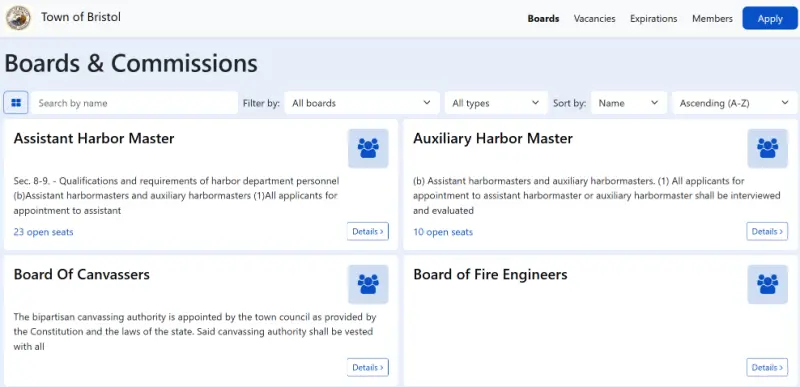
Like most New England towns with deep maritime and civic roots, Bristol’s board structure reflects its history. Alongside familiar bodies like the Board of Canvassers — the bipartisan authority responsible for administering elections under the town’s charter and state law — Bristol maintains boards tied directly to its identity as a working harbor town, including Assistant Harbor Master and Auxiliary Harbor Master positions, along with the Board of Fire Engineers.
Each of these boards comes with its own appointment rules, qualifications, and seat counts. Multiplied across a full roster of town boards and commissions, that’s a lot of detail for a clerk’s office to track by hand — particularly when seats open up on different schedules and residents are trying to figure out, in real time, where they might be able to serve.
Making Vacancies and Applications Visible to Residents
OnBoardGOV’s public-facing board directory gives Bristol residents a single place to browse every board and commission the town maintains. Visitors can search by name, filter by board type, and sort results — and each board listing shows a short description of its purpose alongside the number of open seats.
That last detail matters more than it might seem. A resident interested in civic involvement doesn’t need to call the clerk’s office or dig through meeting minutes to find out whether a board is even accepting applicants. They can see it listed plainly: Assistant Harbor Master, for example, with its open seats displayed right on the board card, next to a “Details” link for the full description and requirements.
From there, the Applications module carries that visibility through to action. Instead of routing interested residents through email or paper forms, Bristol can let people apply for open board seats directly through the same system that tracks membership, terms, and vacancies — keeping the entire lifecycle, from public listing to appointment, in one record system rather than scattered across spreadsheets and inboxes.
Accuracy Behind the Scenes, Transparency Out Front
For the clerk’s office, the benefit runs in both directions. Centralizing board rosters means term expirations and vacancies are tracked automatically rather than caught after the fact, and member information only needs to be updated once — even for residents who serve on more than one board. For the public, it means the kind of straightforward access to civic process that Bristol has built its identity around for over 200 years: a clear, visible way to see what’s open and how to get involved.
It’s a fitting pairing. A town that has spent more than two centuries treating public participation as something to be celebrated and made visible now applies that same principle to the everyday mechanics of local government — one board listing, one open seat, one application at a time.
Want to see how OnBoardGOV’s Applications module could work for your town’s boards and committees? Book a demo to walk through it with our team.