In every community, boards and committees are where much of the real work of local government happens. Appointments are made, terms are tracked, vacancies open, and residents look for ways to get involved. Keeping all of that organized, accurate, and easy to find is not a small task.
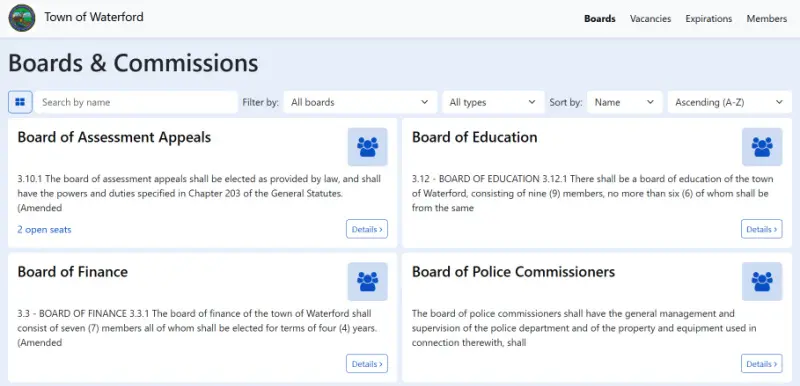
In Waterford, Connecticut, that work is handled with a clear, centralized approach. The Town uses OnBoardGOV to manage its boards and committees in a way that supports both staff workflows and public visibility.
A Clear System for a Complex Responsibility
Managing boards and committees often means balancing multiple moving parts at once:
- Active and expired terms
- Current appointments and upcoming vacancies
- Board structures and member roles
- Public interest in participation
In Waterford, this information is organized in one place, creating a consistent and reliable source of truth. Instead of relying on multiple spreadsheets, documents, or internal tracking systems, staff can view and manage board data as part of a single, structured record.
As a result, day-to-day tasks become more straightforward. Staff can confirm information quickly, answer questions with confidence, and maintain accurate records without duplicating effort.
Supporting the Clerk’s Office
For a clerk’s office, board and committee management is both administrative and public-facing. It requires precision, consistency, and accessibility.
In Waterford, OnBoardGOV supports that work by:
- Keeping board and committee records organized and up to date
- Providing a clear view of member terms and appointment history
- Making it easier to track and report on vacancies and upcoming expirations
- Offering a structured way to maintain historical continuity over time
This structure helps reduce the friction that can come from scattered records or unclear versioning. It also supports internal consistency, which is essential when multiple staff members interact with the same information.
Making Information Easier to Find
“Findability” is not just a convenience. It is part of how local government serves its community.
When board and committee information is easy to locate and understand, residents can:
- See how local boards are structured
- Understand who is currently serving
- Identify opportunities to participate
In Waterford, organizing this information in a single, accessible system helps reduce the need for follow-up calls or manual lookups. Residents are better able to find what they need, and staff spend less time directing or clarifying.
A Trusted Approach in Practice
Adopting a new system is one thing. Using it every day, and recommending it to peers, is another.
David Campo, Town Clerk in Waterford, Connecticut, recommends OnBoardGOV for its ease of use and responsive customer support. His experience reflects what many clerks are looking for: a system that works the way they do, without adding unnecessary complexity.
Built Around the Work You’re Already Doing
Every clerk’s office has established processes. The goal is not to replace that expertise, but to support it with tools that make the work more manageable and more visible.
Waterford’s approach shows what that can look like in practice:
- One place to manage board and committee information
- Clear records that support both current operations and historical context
- Information that is easier for staff to maintain and for residents to access
For communities reviewing how they manage boards and committees, it is a useful example of how structure and clarity can support both internal workflows and public service.