
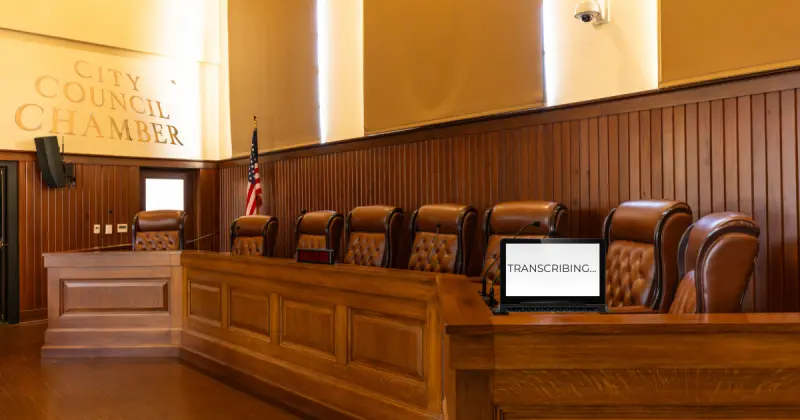
AI note-taking tools have made it easy to generate a full transcript of a meeting without anyone typing a word. That convenience comes with a records question clerks can’t really opt out of: the moment a transcript exists, is it a public record — and if so, for how long does it have to stay one?
The honest answer right now is that it depends on where you are, and the guidance is still catching up to the tools. A few states have written the rules down. Most are still applying older public-records law to a technology it wasn’t written for. And the people teaching clerks how to use these tools aren’t always the same people setting rules for what to do with what they produce.
Some states are already writing the rules
Indiana is the clearest example. Under Indiana Code 5-14-1.5-2.9, which took effect in mid-2025, the state’s records administration has issued explicit guidance: turning on an AI note-taking bot to create a meeting record means the agency is responsible for reviewing those notes for accuracy and retaining them under the standard retention schedule — the same one that already governs meeting recordings and minutes. If a transcript will be made public or used to prepare official minutes, someone has to review it for accuracy first. An unreviewed AI transcript isn’t treated as good enough on its own.
Washington has taken a similar approach from a different angle. The state archivist’s guidance on managing generative AI records doesn’t create a brand-new category — it maps AI outputs onto the retention schedules that already exist. Using AI as a sounding board for brainstorming may be transitory and disposable once it’s served its purpose. But if that same AI output becomes the basis for an ordinance or a strategic plan, a real retention period applies. The output’s fate depends on what it’s used for, not on the fact that AI produced it.
Maryland’s Department of Information Technology has gone further than most in naming the specific technology: it has issued guidance addressing AI-powered call recording and transcription tools directly, rather than treating them as one example under a general AI policy. And in Virginia, the Library of Virginia — the state’s archives — has reported a rising volume of agency questions about how AI-generated records fit its existing retention schedules, guidance that’s actively being built out in response to what agencies are actually asking.
Other states are relying on the public-records law already on the books
Not every state has written AI-specific rules, and that’s not necessarily a gap — in some cases, existing law already covers it. North Carolina hasn’t passed anything AI-specific, but a University of North Carolina School of Government analysis walks through how the state’s existing Public Records Act already applies. The analysis flags a nuance worth knowing regardless of which state you’re in: some AI outputs, like intermediate drafts or prompts, may qualify as “transitory records” once a final version is approved. But it’s careful to note that something which looks transitory on its surface can still carry a required retention period once you actually check the schedule. “It was just a draft” isn’t a safe assumption to make without checking.
The gap between AI training and AI guidance
Here’s the piece that doesn’t show up in any single state’s guidance: clerks are being trained to use these tools faster than anyone is telling them what to do with the output. IIMC offers a paid course on AI and automation for municipal clerks, and regional groups like the New England Municipal Clerks Institute run recurring webinars on using tools like ChatGPT for meeting-related work. That’s genuinely useful training. But it’s training on the tool, not guidance on retention — the organizations teaching clerks to generate a transcript faster aren’t the ones deciding how long that transcript needs to be kept, or whether it’s a public record the moment it’s created.
That gap is exactly why some municipalities are writing their own AI policies rather than waiting for state-level rules to catch up. We covered how to approach that in Why Your Municipality Should Consider AI Guidelines — and How to Create Them, which is worth a look if your office is using AI tools without anything in writing about what happens to what they produce.
What this means if your state hasn’t weighed in yet
A few things are worth doing regardless of what your state has or hasn’t said:
- Check whether your existing retention schedule already covers it. Most general schedules include categories for meeting recordings and minutes. An AI transcript may fall under one of those categories even without a rule written specifically for AI — as North Carolina’s guidance shows.
- Don’t assume “not final” means “not a record.” A document that looks like a rough draft can still carry a retention obligation depending on what it’s used for, as Washington’s transitory-vs-not distinction makes clear.
- Build in human review before anything goes public. Whether or not your state requires it in writing, treating an unreviewed AI transcript as final creates accuracy risk independent of the records question.
- Ask what happens to the transcript on the vendor’s side. If the transcription happens through a third-party tool, know whether that tool retains a copy, for how long, and whether that copy is something you’d need to account for in a public-records request.
- Consider writing your own policy rather than waiting. If your state or association hasn’t issued guidance, that’s a decision your municipality can make on its own, rather than a decision you have to wait to have made for you.
None of this is settled enough to give a single clean answer yet — which is exactly why it’s worth checking in on periodically rather than assuming today’s practice will hold. We’ll keep tracking how state guidance develops.