
Back in 2021, we wrote about what researchers were calling a “silver tsunami” — a wave of local government retirements picking up speed as the economy improved and the pandemic wore on. In 2022, we followed up with what the data was showing about why people were leaving: burnout, compensation, work-life balance. Both pieces were written in the present tense of a trend still forming — something clerks’ offices were watching, not yet something they’d fully absorbed.
Three years later, the numbers aren’t a forecast. They’re a count. And because the clerk’s role rarely does just one job, an empty seat doesn’t just leave a staffing gap — it leaves several at once.
How big is the municipal clerk shortage?
Between 2020 and 2024, more than 700 municipal clerks in Wisconsin left their posts — the highest raw turnover of any state in the country, according to the Bipartisan Policy Center’s figures as reported by Votebeat Wisconsin. Wisconsin is a useful bellwether here because of how its system is built: the state requires all 1,850 of its municipalities to run their own elections, which means it leans harder on small-town clerks than almost anywhere else. When that layer thins out, there’s no larger county office to absorb the gap.
Marathon County offers a close-up view of what that thinning looks like in practice. Of the 13 new municipal clerks who took office there after the April 2025 election, four resigned within months, and a fifth clerk, in the city of Wausau, stepped down not long after (also via Votebeat).
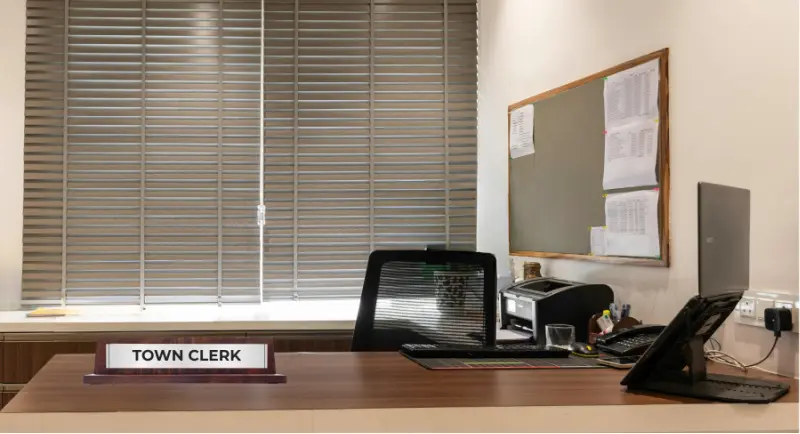
In the town of Wausau, that left the clerk’s seat empty until a longtime town supervisor stepped in to cover it — not because she sought the role, but because no one else came forward (Wisconsin Watch). Her term runs through April 2027. Nomination papers for whoever might succeed her are due in January of that year, and as of now, no successor has been identified.
It’s not only about elections
Election administration is the most visible function that goes vacant when a clerk’s seat empties — someone still has to run the next election, and in a lot of small towns, the clerk is the only person trained to do it. But the role carries several other duties that get less attention until they’re missing:
Records custodian. Clerks are frequently the official keeper of public records and the person who fields open-records requests. Without institutional memory of where things live and how requests have historically been handled, response times and accuracy both suffer.
HR and succession resource. In many municipalities, the clerk’s office is the de facto HR department, helping other staff and departments plan for their own transitions. When the clerk’s seat is the one that’s empty, that function disappears right when it’s needed most.
Board and commission liaison. Clerks often manage meeting logistics, agendas, and minutes for multiple boards and commissions at once — institutional knowledge that doesn’t transfer easily to whoever fills in.
A single vacancy touches all of it simultaneously, which is part of why the “cresting wave” framing has started to replace the “coming wave” language researchers used a few years ago.
Why is this described as “cresting” rather than “coming”?
Public-sector HR researchers, including consultancy CPS HR Consulting, have started describing this less as a wave still building and more as one that’s already cresting. That shift in language matters, because it changes what the useful question is. The 2021 and 2022 conversations were largely about why clerks were leaving and what might convince them to stay. That’s still worth asking. But the Wisconsin numbers point to a second, more immediate question: what happens to elections, records access, and everything else the clerk’s office touches, in the towns where the seat is already empty and there’s no one lined up to fill it?
Some of that is about recruitment. Wisconsin lawmakers have taken a swing at it, passing a law that makes it easier for small towns to appoint clerks rather than require them to live within municipal boundaries and stand for election (Votebeat Wisconsin). County officials interviewed for that coverage were candid that it’s a partial fix, not a full one — a bill can lower the barrier to hiring, but it can’t manufacture more people willing to take on a role that carries this many responsibilities at once.
When the succession planner is the one who’s gone
We wrote about succession planning last year in Succession Planning Success, built around ICMA’s “peak 65” data on local government retirements. That piece is about clerks helping their municipalities plan for other departments’ transitions — preserving institutional knowledge, identifying key roles, mentoring successors. It assumes the clerk is still at the desk to do that work.
The Wisconsin numbers complicate that assumption. When the clerk’s own seat is the one sitting empty, the office that municipalities lean on to plan for succession is itself the thing that needs succession planning. That’s less a staffing problem than a continuity problem — and it’s the subject of a companion piece, [Plan for Your Own Transition, Too], which looks at what that planning looks like when it’s pointed at the clerk’s own office instead of everyone else’s.