
East Lyme-web
East Lyme, Connecticut wasn’t always one town. It was formed in 1839 out of pieces of Lyme and Waterford, joining two places that had very different identities: Flanders, an inland farming and mill community along the old Post Road, and Niantic, a coastal fishing village on Long Island Sound that later became a summer destination. Nearly two centuries later, East Lyme is still, in a sense, managing two distinct halves under one municipal government. Its board and committee structure reflects that scale directly: the town currently maintains 75 active boards and committees, handling everything from the ten-member Board of Education to the Zoning Enforcement Officer role, using OnBoardGOV, ClerkBase’s board and committee management platform for local government.
Board and committee management is harder than it looks
Keeping track of one or two boards is manageable. Keeping track of 75 — each with its own term lengths, seat counts, and vacancy timelines — is a different kind of challenge. Terms expire on different schedules, some seats sit open longer than they should simply because nobody flagged it, and residents looking to get involved often have no easy way to see what’s actually available.
That’s the kind of operational load that tends to hide in plain sight. It doesn’t show up as a single crisis; it shows up as a slow accumulation of small gaps — an expired term nobody caught, a vacancy that’s been open for months without anyone realizing.
What East Lyme’s board directory shows
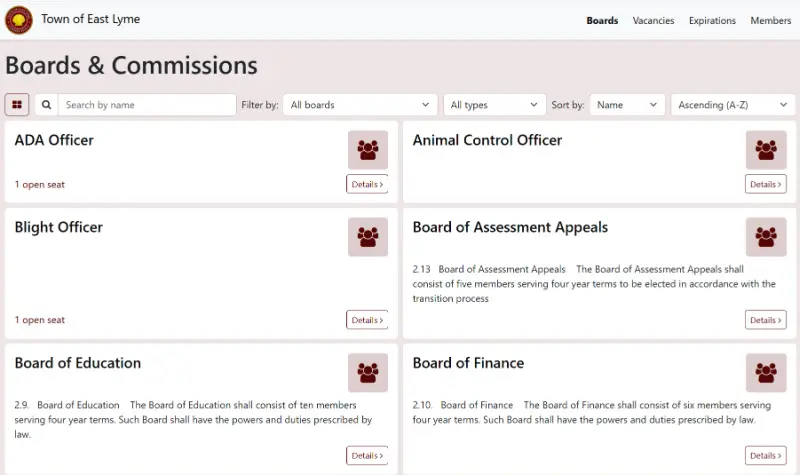
East Lyme’s public boards and commissions page, built on OnBoardGOV, gives a clear sense of how the town handles that scale. Residents can search by board name, filter by board type, and sort the full list — from the ADA Officer through the Zoning Board of Appeals. Each listing shows open seats and term details drawn directly from the town’s ordinances, so the governing structure isn’t buried in a separate document — it’s attached to the board record itself. A single click shows all the vacant seats, and another report shows upcoming term expirations.
That kind of visibility does double duty. For staff, it means term and vacancy tracking doesn’t rely on someone remembering to check 75 separate expiration dates. For residents, it means the question “is there a board I could actually join?” has a straightforward answer, rather than requiring a call to the clerk’s office or a search through old meeting minutes.
Consistency residents can see
A public board directory only helps if people trust it’s current. When vacancy and term information stays accurate and up to date, residents get a dependable answer every time they check — not something that’s occasionally out of date and quietly undermines confidence in the process. For a town with 75 boards running in parallel, that consistency is the difference between a directory people actually use and one they learn to double-check by calling in anyway.
The bottom line
East Lyme’s board structure is a genuine test case for what it takes to keep board and committee information organized at scale — 75 active boards is a lot of moving parts to track by hand. OnBoardGOV gives the town a single, searchable source of truth for that work.